
Two surveys, taken two years apart, show Florida voters adopting AI faster than they’re learning to trust their local government with it. Here’s what that means for your city, plus a practical guide to using AI well.
By Ryan Cohn, Chief Strategy Officer and Partner, Sachs Media
One number showed up twice in this year’s survey, and it told two very different stories.
Two years ago, 41% of Florida voters told us they had used a generative AI tool. This year, that figure jumped to 68%. Yet the exact same share, 68%, said they don’t trust their local government to use AI responsibly. Floridians are comfortable using AI themselves and skeptical when their city does, and that gap is where the work begins for anyone who runs a Florida city.
I presented these findings at the League’s Annual Conference in August. When we first ran this survey in 2024, I argued that municipal leaders should lead on AI. The newest numbers show how quickly the ground has shifted since then, and why that leadership matters even more now.
A public that already uses AI
Most Florida voters now use AI, and the biggest gains didn’t come from younger residents. They were already on board, with 65% of voters under 45 using generative AI back in 2024. The growth came from the residents cities often assume they can skip when it comes to technology. Among voters ages 45 to 64, use jumped from 41% to 76%, the largest increase of any age group. Use among voters 65 and older more than doubled, from 21% to 50%.
That should change how cities talk about AI. Talk about it the way you’d talk about any other tool your residents already use, because most of them do, and don’t write off any audience because of its age.
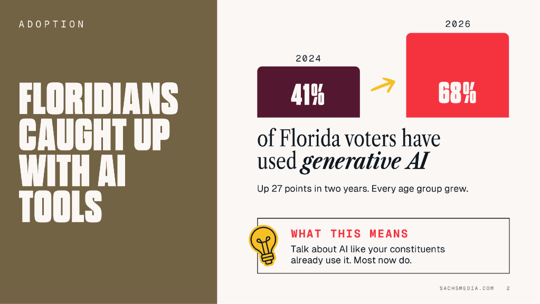
Figure 2
Personal use of generative AI among Florida voters, 2024 to 2026. Source: Sachs Media survey of Florida voters.
Residents also see more ways AI could help. This year, 69% named at least one way AI could benefit local government, up from 61% in 2024. Efficiency is still the benefit people mention most, but communication is climbing fastest. The share of Floridians who say AI could make a city’s communication with residents clearer grew from 27% to 40%, the biggest jump of any benefit in the survey.
Clarity is the least flashy item on the list. It’s also a much smaller promise than the one the tech industry keeps making, and it’s a promise a city can actually keep. Efficiency still sells, but opinion is shifting toward clarity, and it’s the stronger argument to lead with.
Where the worry has moved
The public’s concerns have shifted, too. Privacy and data security now top the list, named by 69% of voters, up from 63%. Bias in AI systems, the leading concern in 2024, fell from 66% to 54%. That gives cities a clear rule: Every time you announce a new AI tool, say plainly how you’ll handle and protect residents’ data.
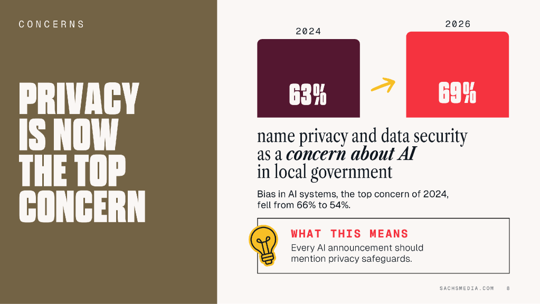
Figure 3
Top concern about AI in local government, 2024 versus 2026. Source: Sachs Media survey of Florida voters.
The politics of AI changed as well, in a way worth watching. In 2024, Democrats and NPA voters were the most open to AI in local government, and Republicans trailed. By 2026, those lines had crossed. Republican support rose 13 percentage points while support from the other two groups fell, and Republicans now lead on most measures. My advice is to make the case for AI across party lines instead of tailoring it to whichever group seems most receptive this year.
A public still making up its mind
For all that movement, most voters still haven’t formed a firm opinion about AI. When we asked whether officials should actively use AI, the firm answers on both ends shrank. A definite “yes” slipped from 16% to 12%, and a definite “no” fell from 25% to 15%. The persuadable middle grew 14 percentage points, to 73%.
That’s an opening. Cities that make their case now, before opinions harden, can reach far more people than they’ll likely be able to reach a few years from now.
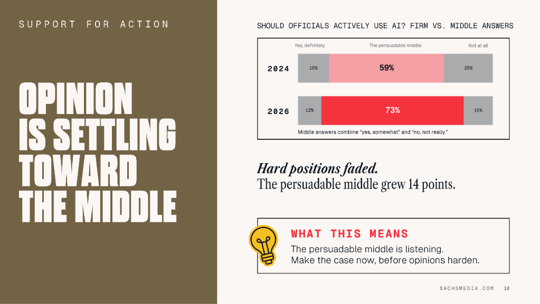
Figure 4
Should officials actively use AI? Firm answers versus the persuadable middle. Source: Sachs Media survey of Florida voters.
Underneath the openness sits real unease. In this year’s survey, 63% of voters said they expect humans to lose control of AI someday, and 57% think it will happen within 10 years.
That wariness follows residents to city hall. When they contact their local government for help, 73% would not be comfortable dealing with an AI chatbot instead of a person, and only 4% would be very comfortable. Whatever residents do with AI on their own time, most of them don’t want a bot standing between them and their city. Offer AI as an option, never as a wall, and keep a person one step away.
The trust gap, and how to close it
Residents use these tools every day, and they still doubt their government will use them well. That doubt shows up most clearly in the group you’d least expect: voters under 45, the same residents who adopted AI first.
A city closes that gap the same way it earns any other kind of trust: by being specific and saying it consistently. The League’s guide on communicating clearly and honestly about AI boils it down to four questions every city should answer in public. Why are we using AI? What does it do, and what doesn’t it do? How is data protected? Who is accountable when something goes wrong?
Some Florida cities already do this well. Tamarac, for example, maintains an AI page on its website that lists the tools the city uses with a plain-language description of what each one does.
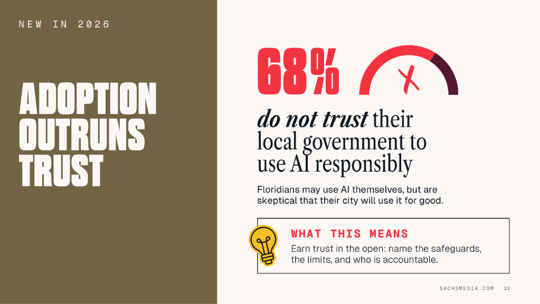
Figure 5
Adoption has outrun trust: most residents who use AI still doubt their city will use it responsibly. Source: Sachs Media survey of Florida voters.
A practical playbook for using AI well
The second half of our conference session on AI and local government focused on what officials do with these tools day to day, and the habits that trip them up. Almost every fix comes back to the same idea: AI gets a lot more useful the moment you stop asking it to be you.
A few of those moves fit city work especially well:
- Use AI to listen, not to talk. Instead of asking AI to write a statement on a rezoning when you already know your position, hand it the 300 emails residents sent about the rezoning and ask what people are actually worried about.
- Translate, don’t inflate. A request for a newsletter about the budget gets you 1,200 words nobody finishes. Ask instead for a 100-word version that a resident who has never been to a meeting could follow.
- Rehearse, don’t script. If AI writes your remarks on a millage increase, the room will know it wasn’t you. Ask it for the 10 hardest questions you’re likely to get, and walk in ready.
- Give it the source. AI that answers a policy question from the open internet can easily get your city’s rules wrong. Hand it the actual ordinance and tell it to answer only from that document.
- Make AI your biggest critic. Ask AI whether your plan is good, and it will almost always say yes. Ask for the strongest argument against the plan instead.
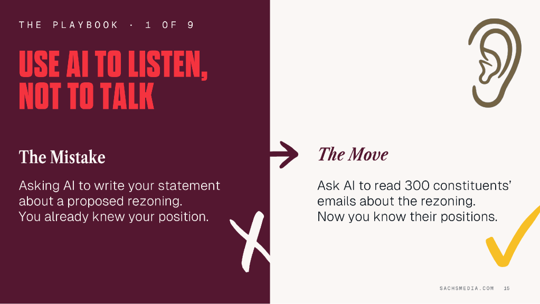
Figure 7
One of the nine moves: use AI to understand what residents are saying, not to restate what you already think. Source: Sachs Media.
The habit I’d break first is the quiet one: using AI and hoping nobody notices. You’re far better off saying plainly that your city uses AI and getting ahead of the question. In Florida, hoping nobody notices isn’t much of a plan anyway. Prompts, drafts, and chat logs tied to official business can qualify as public records under Chapter 119, Florida Statutes, as the League’s records retention guidance on AI explains.
Residents are ready to hear their city’s AI story, and most haven’t made up their minds, but they won’t stay undecided forever. Cities that tell their story now and back it up with real safeguards will keep the public with them as the technology evolves.
If you’re wondering where to start, start with clarity. Use AI to help your city communicate in a way residents can actually understand, and then tell them how you did it.
Figures from a Sachs Media survey of Florida voters conducted in 2024 and again in 2026, presented by Ryan Cohn, Chief Strategy Officer, Sachs Media, at the Florida League of Cities Annual Conference, August 2026. Slide graphics courtesy of Sachs Media.